

Over the last 10 years I've worked with a range of software companies, most recently as account director at alumi. In that time I've seen what works and what doesn't, including helping SharpCloud build the kind of digital and sales performance that led to their acquisition by Lumivero earlier this year.
At alumi, we’ve worked with a number of software companies over the last few years, across roadmapping, AML, PSPs and media software to name a few. This article is a distillation of what we’re seeing on the ground right now.
In this article I’ll cover some of the digital challenges facing marketing teams in the software space, what you can do about them and how the future looks. Rather than all challenges, I’m going to focus on the very current ones.
This has been happening over the last couple of decades, buyers have been getting more and more sophisticated and generating MQLs that convert into SQLs is getting harder every year.
What has changed in 2026 specifically is behaviour and increased fragmentation across digital channels has accelerated.
Sales cycles are reported to be between 30 days and over 9 months depending on the industry and company. The median sales cycle is 84 days, whereas optimal is 46–75 days (Digital Bloom).
Closing that gap is one of the most important levers available to software marketing teams right now in generating more MQLs which are sales-accepted.
This is compounded by the fact sales cycles now start in the dark. Before buyers go out to market for a demo, they are consuming content, gathering opinions and searching in a variety of new channels.
What used to be a simple search → website → conversion model has become increasingly multi-touch.
This graph by Becky Simms illustrates the complicated multi-touch journey users make in 2026:
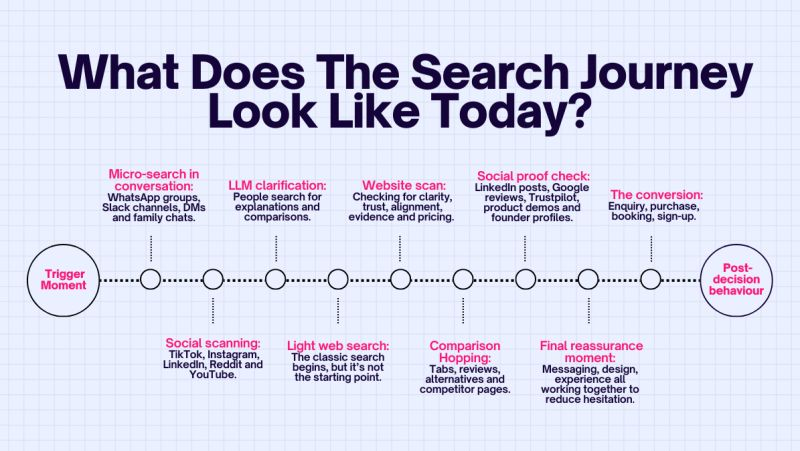
Buyers are doing more on their own, but they still need human input to build trust and make decisions. We think the real opportunity is in integrating both.
A March 2026 report from SurveyMonkey and Reddit on B2B buying behaviour puts some hard numbers on this shift:
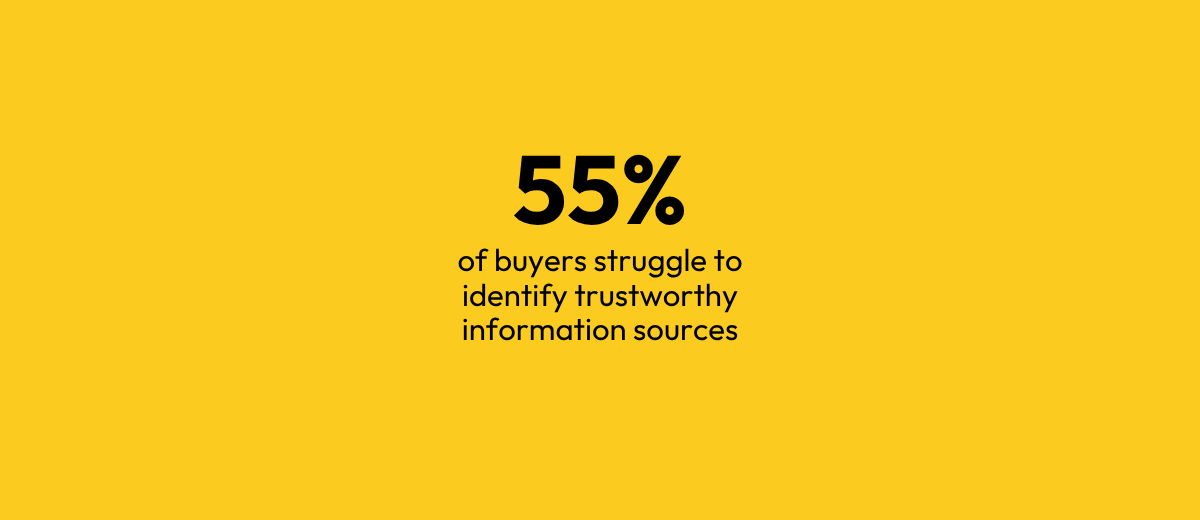
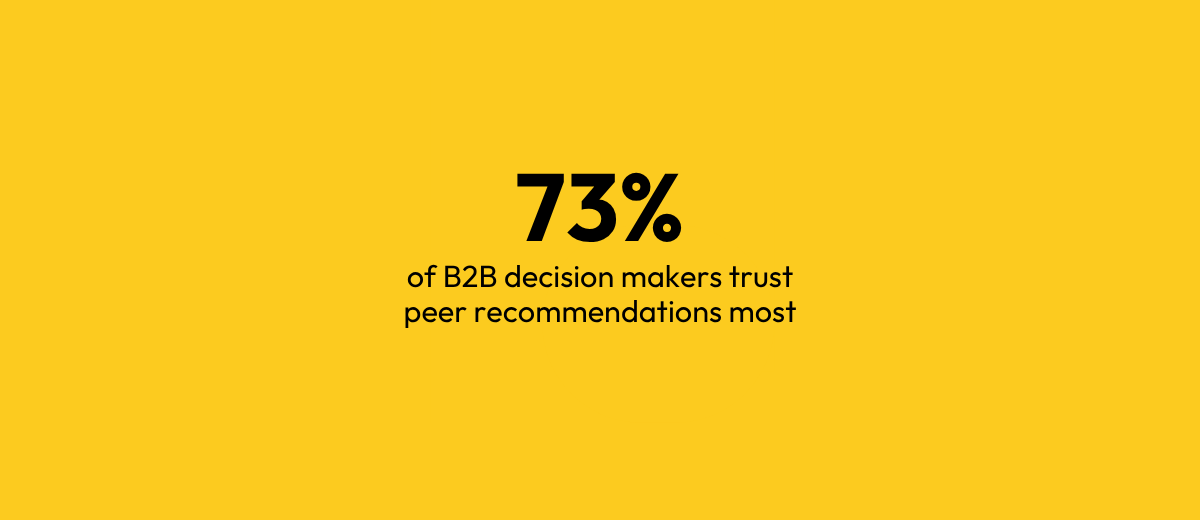

The last figure is the one that should concern software marketing teams.
If 83% of your buyers have already formed a view before they contact you, the question isn't how good your sales team is, it's whether your reputation, your content and your peer presence shaped that view, or someone else's did.
Not only is generating enquiries hard, so is measuring accurately. It's the most persistent pain in software marketing.
What makes it especially complex in software marketing is the committee-led approach to buying, reliance on third party endorsements.
Many software buying decisions are influenced in Slack communities, WhatsApp groups, Discord servers, and private LinkedIn DMs.
This compounds the pre-existing problem in marketing. Hidden sources, mixed channel attribution and cookies are getting in the way of a clear picture digitally.
GA4 has become for some clients a really poor source of visibility. On top of that you’ve got dark social, VPN browsing, and now AI-generated answers which drive brand searches.
Attribution models completely miss, and it’s making decision making difficult.
The number of channels to focus on grows every year, and it’s difficult to keep spreading focus to new channels.
One channel that definitely does require attention is AI generative search. 94% of B2B buyers now use LLMs during their purchase journey (6Sense, 2025 B2B Buyer Experience Report)
LLM usage tends to be lower during initial category research but becomes heavy during shortlisting, costing and RFP planning stages.
What this means in practice is that by the time a prospect contacts you, they've already used AI to educate themselves, compare options and in some cases draft their requirements.
What this really means is that as I alluded to earlier, we’ve got buyers that are self-educating so when they finally do get in touch, they’re very far along the decision process, thanks to online research and now AI tools too.

Source: 6Sense 2025 B2B Buyer Experience Report
It’s also worth considering AI agents as a new buyer touchpoint. This is an emerging tech to be aware of and an extension of the need for AI visibility.
Increasingly, AI agents (used for procurement research, vendor shortlisting, RFP prep) are querying the web autonomously, on behalf of procurement teams. That will also extend to end-users in the near future, as companies further adopt agentic AI into the workforce.
This is huge and definitely an undertalked problem in software marketing.
B2B buyers in 2026 are sophisticated, research-led, and can be actively resistant to marketing efforts. The data backs this up: according to the 2025 Edelman-LinkedIn B2B Thought Leadership Impact Report, 71% of decision makers say less than half of the thought leadership content they consume gives them valuable insight.
In order to cut through the noise and gain attention, content needs to not only cover the topics they are interested in, but also display the level of expertise and experience that they themselves have.
A lot of digital software marketing content misses the mark for a few key reasons:
Additionally, research from SEMRush shows that in traditional search, human-written content is 8x more likely to rank position 1 than AI-generated content.
That means it’s not great for users, engagement or online visibility.
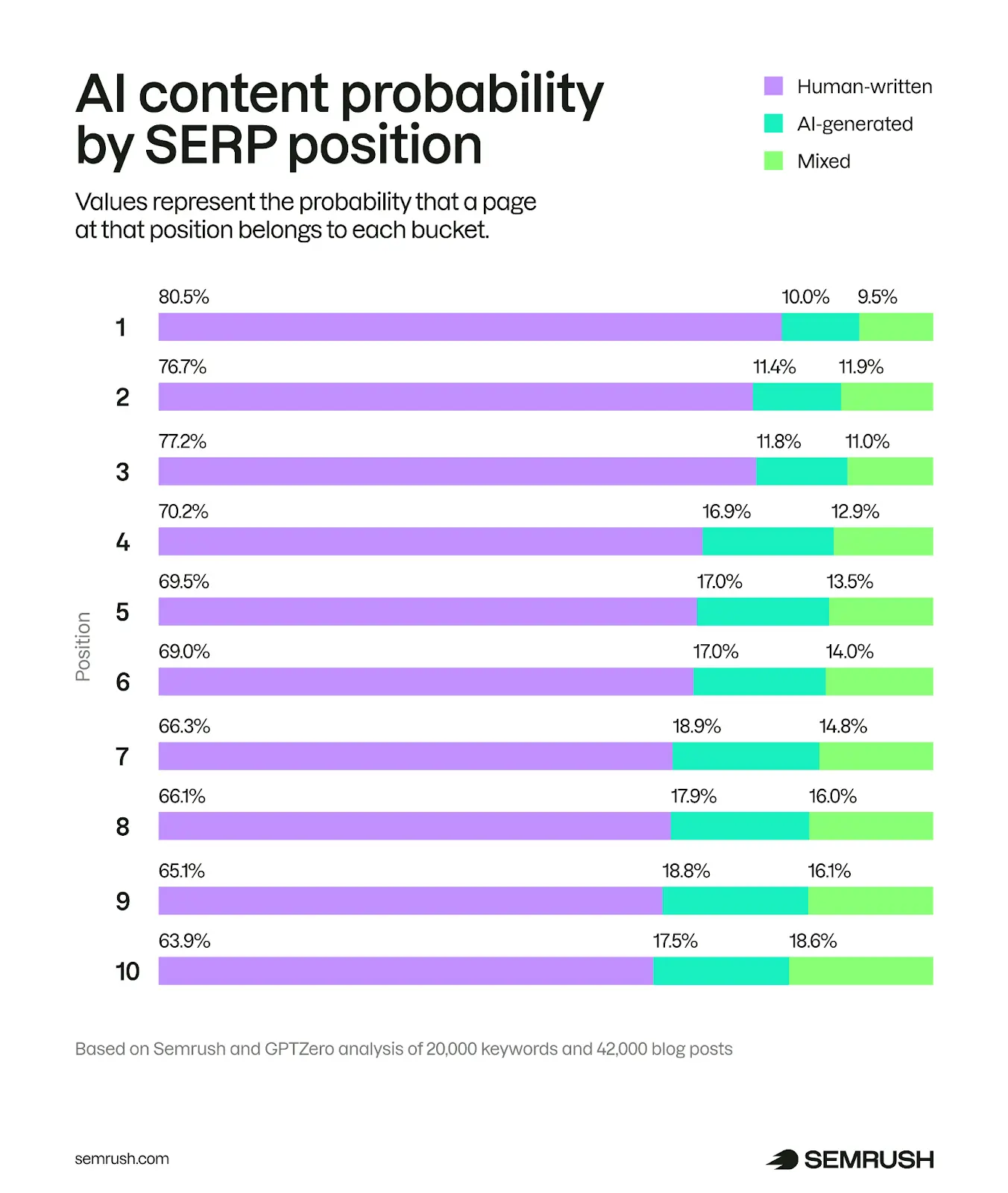
Source: SEMrush
In an effort to ramp up results, teams are looking to speed up, whether through AI assisted or AI produced content, or simply higher volumes of human created, low quality content.
The result is that average content quality has collapsed and buyers are ignoring more. The same Edelman report found that poor thought leadership actually damages credibility, 39% of decision makers said it had led them to question a vendor's competence.
In software, where trust is already hard-won, that's a costly mistake.
The marketers who win are those producing genuine insight, original research, or expert POV, written or co-created by the experts.
The irony is that AI is both the cause of the execution quality problem and, used correctly, part of the solution. Every marketing team is using generative AI in some form now, but not always strategically.
Most teams are still prompting ChatGPT, Claude or Gemini for drafts and summaries.
Meaningful efficiency gains come from building with AI rather than just using it and agentic systems where AI handles defined, repeatable workflows autonomously, and the marketing team's job shifts to steering, reviewing and evolving those systems.
The danger is that LLMs are confidently wrong with a frequency that makes unsupervised deployment risky.
A 2024 Stanford study found hallucination rates ranging from 3% to over 27% depending on task type. In a B2B software context buyers are specialists who will notice inaccuracies.
This is an ongoing and iterative, experimental process. AI isn’t good for strategy or execution of customer facing content in my view, but can speed up processes around low level execution, repeatable tasks, reporting and day to day efficiencies.
The challenges in this article are not necessarily new, though they do have a new flavour. Lead quality, attribution, sales and marketing alignment, execution quality, software marketing teams have been wrestling with these for years.
What's different in 2026 is the pace and the stakes. AI is accelerating buyer sophistication, fragmenting the channels we rely on, and raising the bar for what good looks like.
The teams that move fast, stay integrated and keep quality high will pull ahead. The ones that don't will find the gap harder to close every year.
What do you think? I'd love to hear your thoughts on challenges you're facing, how you're tackling them, or just general feedback. I'm on arek@alumi.marketing and I'd love to hear from you.